Showing posts with label Phil Westcott. Show all posts

Friday, January 4, 2013

Bouldering 2012

Raina McRae photo
(above) Windmill Boulders on a numbing October day in 2012.
          
           Bouldering constitutes the matrix in which Kigs climbs are embedded.  A "real" climb gets a post if it protrudes in any way from the ordinary substance of everyday bouldering.  Packed tightly in between goal-oriented trips to the mountains lies any number of forgotten trips to local boulders, crags, scrags, scarps, frozen slag heaps, gravel mounds, pressure ridges, quarries, seawalls, rooves, dredges, tailings piles, all the trash in between, which, if the imagination is vivid enough,  provide more than a bare minimum of vertical terrain upon which to execute continuous kundalini-producing climbing moves.


(above) Nate and Raina on the Class 3 approach to Sunset Rocks, Norton Sound to the south, November 2012.

      More than any Alaskan town I can think of, Nome has bouldering close to town.  Within the radius of a casual trip from home, one finds the innocuous, but satisfying and unpatrolled klettergartens of Anvil Mountain, King Mountain, Banner Ridge (Windmills), Sunset Rocks, Penny Boulders, Penny Crags, Engstrom's Mountain, (Sitnasuak, Bering Straits, BLM, and I don't know what else lands!!) endless little lumps, mudcliffs, junkpiles, decaying cliffs composed of all  three geologic categories of ROCK and all possible combinations in between (with perhaps too heavy a proliferation of "metamorphic").  Pick a dark smudge on the tundra from the road, and chances are it's the tip of an iceberg;  hike over to it and the ground drops away revealing grottoes, hollows, overhangs...  gradual testing reveals the problems to be solid enough to support bodyweight (at some humidities, laugh out loud) lifetimes of climbing, if the imagination is vivid enough.
Phil Westcott photo.
(above) King Mountain, October 2012.
  
          Many climbers step off the plane.  But how many climbers that stay in town stay climbers?   Hunting draws off many.  Skiing has sucked off more than a few.  Dog teams keep able partners glued to their compounds.  Lack of alpine skills hinders some.  The sheer burden and misery of truly getting out in the Kigluait—  you know, the valid argument that the spanking you get isn't really worth the climbing you get—  kills off most.  Unless the climber steps off the plane equipped with a distracted, ADHD-mind that can wander the steppes aimlessly happily swarming over any lump of vertical ground like an ant crawling over a lump of sugar, enjoying the moves, the sheer joy of moving over stone, close to town, in pointless pursuit of imaginary problems far away from the high Kigluaiks where it really counts, he or she will not remain active as a climber, for it is the BOULDERING that gets one through on a weekly basis in Nome.
Phil Westcott
(above) Fake off-width, King Mountain, October 2012.

      Estimated percent days on which an outdoor wilderness bouldering event or climbing event occurred in 2012, for me personally:  48%.  Not bad for a post-hernia year.  Endless rock-shoe trips to the Sunsets and Pennies, one awesome day combination dry tool / rock shoeing up the entirety of Engstrom's Mountain in clear autumn breeze, plenty of King Mountain both with ropes and without, a week or two of clandestine mud-mounding in the tailings piles, and numerous trips to the Windmill Boulders chinked in between the other days.  "Been getting out in the country?"  Well, no, been bearhugging the tarry timbers of this old mining truss, been violently blowing out Cobra hooks off rounded schist with my ass already touching the ground, been playing with little sticks of carbon fiber looking for all the world like a two-year old, been taking naps inside the grassy chimneys, but no, haven't really escaped the event horizon of THE GLUE OF TOWN for weeks.

(above) Windmill Boulders, 5.9 section of Borehole Traverse (V0), September 2010.  First ever video on Kigsblog, thanks to Mikey Lean.

    Brain function necessary for kinaesthetic repetition of specific climbing moves generates electromagnetic energy body patterns which are particularly conducive to promoting the perceptual functions of intuition and other transpersonal intelligences.  Bouldering, through repetition of climbing moves, generates its corresponding electromagnetic energy body, hence a degree of psycho-spiritual interface, which in turn profoundly alters the chemistry and culture of the cells that constitute the climbers organism (cheap adrenalin rushes being one of the more concrete examples of this alteration ), the effects of which linger well after the climbing has ceased, due to the magnetization of the causation vectors within the GLUE OF TOWN having been permanently altered by the climbing that took place in the past proximity of the time/space continuum.

(above) Sunset Rocks, "Beginners Wall," M3, Fall 2010.

       The contrast between the banal details of one's life, and the quick and sudden reality of a sketch highball 15 ft. off the deck out in the middle of nowhere, with femur-crunching flakes aimed at your own legs your only hold.  Drove out from town looking for a workout, and now you're sketched out 15 ft. up on soggy, saturated schist flakes feeling like Largo in The Only Blasphemy, but all too soon you're walking back through your own front door into artificial light, and your life-partner is saying something but you can't yet make out what she is saying...
Raina McRae photo

(above) The Windmills have cracks!  Left Ski Track, a schist jam that goes on for many ones of feet.

       Johnson never let on to the other miners when he left the camps to go "Perry-Smithing," what he called his secret climbing trips to the low rocks that abounded in the hills around the Nome diggings.  It was just too peculiar an activity:  jamming your body parts into unstable rock and heaving yourself around like a ballet gymnast.  They might think it too, uh, well, feminine somehow, though they'd all seen him do it more than once when a good stack presented itself.
     One fine, Fall evening, Johnson was drinking deep with the boys up on Anvil Crick, and he staggered out of the canvas tent to confront the deep velvet of a summer night, with everything gone purpley, and the air cooled down making the bugs drop, and Johnson headed on up Anvil Mountain under the midnight sun, with the Anvil itself at the top of the mountain square in his sights.
     When he got up to the Anvil thirty minutes later, Johnson threw himself at the outcrop for all he was worth.  He flew as if up a ladder up the big holds of the south face, used a hand crack to downclimb the north side, and then forced himself to hand jam up the "hanging over" crack on the western, horn side of the Anvil, because Oliver would have made him do so if he were there.  For a moment, looking down with only jagged rocks for a landing, Johnson felt his stomach about to involuntarily relieve itself of his dinner, but again he thought of Perry Smith:  "Nur ein vier!" he would have scoffed.  Johnson made the last move and again stood on the summit, admiring the view of the Sawtooths to the north.  He descended, and spent the next hour clinging to various facets and fissures of the rock.
       Someday in the future, Johnson mused to himself, some joe will repeat my "executions" on these rocks tonight, and wonder if they have ever been climbed before...


(above) Windmill Boulders on Banner Ridge looking south, Nome in the distance, Kigsblog photography staff in foreground, October 2012.  

"All zis hiking is great, but ven vill ve get to ze real climbing? "   John Salathe

          The great of danger of bouldering is softness in the head.  When I get back on a top rope or rappel, I am seized with abject fear—  fear of gear!  Every trauma, mishap, or near miss I have incurred in years of climbing rises before my eyes.  Again, I have to go through the process of rationalizing away the adrenalarms flashing in the fear circuitry, Amygdala!,  Amygdala!, the gear cannot be trusted!  Takes me two or three days of honest roped climbing to work through the fear, every time.  Only then do I realize the extent to which Bouldering has caused parts my climbing brain to atrophy.


(left)  "Mud mounding" on frozen tailings.  Saturated by fall rains, they freeze to the consistency of ice.  A brutish form of surrogate ice climbing is created, probably toxic as well, but often stimulating.


On wilderness bouldering... 

Kigsblog is hereby pronounced guilty of Kigsmongering, and of exerting upon the Earth's remaining wilderness index a negative influence by publishing pictures and information which illuminate these areas of the map hitherto dark.  There is really no excuse for such blatant narcissism.  Soon the BLM lands of the Kigs will be overrun with swarming hordes of bright-jacketed hippies on self-directed quests to find themselves and altered states of reality.  In my defense, I can only offer the lame explanation that writing about the Kigs is a lot of fun. 

(left) Windmills, the Courtyard, unfinished problem.  Haven't heaved the old sack up that last move yet.


(above) Sunset Boulders, "Panfaruq," M5.


   Thanks to Bering Straits, Sitnasak, B.L.M, and Ken who lives at Mile 14....  I don't how it works, but it seems a modern-day miracle that one should go unnoticed (thereby being allowed by proxy) to gambol across one of the last pristine ecosystems left in the country, climbing peaks up and down for nothing, with no great hassle of permits nor proliferation of brown signs with white painted letters pointing the way.  No great squawking of land-ownership pundits is heard;  no agency ever quite gets it together to tame these rolling tundra cragbarrens, and the land goes on basically just sitting there unaware of humans most of the time, which is how it should be, in this hippy's irrelevant opinion.


(above)  Phil Westcot on the Delaminate, King Mountain, September 2012.

     When the hordes of super climbers come invading Nome from the east and from across the Bering Straits, the fate of turf-bouldering in the urban areas of the Seward Peninsula will be thrown into jeopardy.  The Windmills, for instance, have excellent turf traverses early in the season before they are buried by the snow, if you are willing to slide your lower legs down under the bottom overhangs between the rock and ground, which doesn't risk death-by-crushing quite as much once the temperatures are cold and the rock is frozen to a safe level of cohesiveness;  you're pretty much having to yard across on arms swinging tricky, precise swings while locked off. However, I have noticed that even one dry-tooling trip across the west Borehole Traverse denudes the key moss clouds on this rock to a significant extent—  I can only imagine that legions of silly-mixed boulderers would remove every last vestige of turf, rendering the tools truly dry for decades to come. 
      How absurdly lucky the boulderers that came before and the ones here now...  before we have to try and control it all, tie her with fences, drag her down... 

(left) Oro Grande, July 2012.  There are climbs, and there is all the climbing in between.  Bouldering is the matrix, the source code of the climbing that occurs on the heights. 


Wednesday, August 1, 2012

Tigaraha East

     Prior to the ascent of Slimedog (see previous post) three Saturdays ago, Phil and I slogged in to the Sinuk for a repeat of the "East Arete of the East Tig(II, 5.4, big Class 4 approach), the right-hand knuckle in the giant birdy-finger of Tigaraha as viewed from the south in the dead of winter when it's the only mountain not holding snow.  I don't think Phil and I could have achieved success in Crater Creek on the Slimedog (or "Greendog" as we are now calling it, being as the Slimedog is incomplete, having avoided the arete on pitch 1, see previous post) had we not gotten to know each other as climbers beforehand on Tigaraha, 7 Sundays previous.  East Tig seems the way more doable option in a weekend than the taller Grand Tig next door.  More Nomen-climbers should pay the price of one brutal hike to do this climb;  accordingly, I have reached into my brain for this post and clicked on Allow yourself to sound like a guidebook author.  


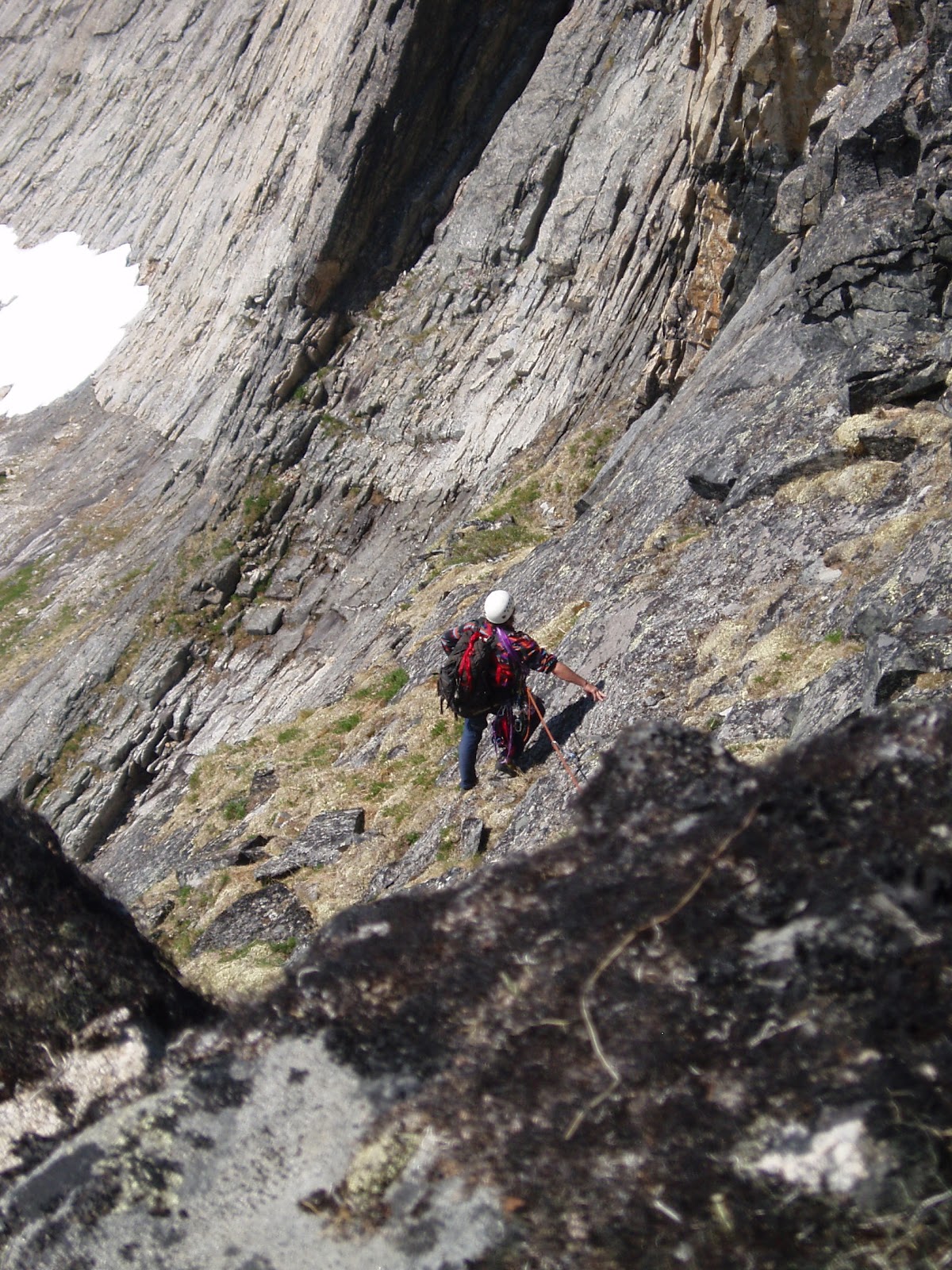
        (above) Phil Westcott on descent of "East Tig", June 2, 2012 ( 5 Saturdays Ago). Much of the route is visible beyond Phil.  The route follows a ramp system perched rather flutteringly over the impressive swoop of the north face of Tigaraha.  A 35 ft. chimney on the summit pitch is visible in the photo as a vertical black line rising out of a notch at the righthand edge of the photo.  In front of that is a rather exposed 5.4 slab.

  5SA The GLUE OF TOWN lay thick and sticky with the post-schoolyear pile-up of personal responsibilities.  The GLUE threw everything it could think of in my way, including, at the last minute, a failed, moose-blood dripping, refrigerator/freezer in my home.  In my blind frenzy to cut through the GLUE with the MACHETE OF SELFISHNESS to make my escape to the mountains, I committed many uncoolnesses;  wasted meat of moose incurred loss of karma points.  Thanks go out again to life-partner Kristine whose own nonentropy field counterbalances my own considerable disorder, and without whom no Kigsblog would be able to combine action with rave and spew.  
      Part of the urgency of the climbing window at the time 4SA was the dual presence of those two most rare commodities: good weather in the Kigs, and a motivated partner.  Phil Westcott was here for the Spring in the employ of the National Park Service and seemed to have the right set of rather off-beat qualifications to make a proper Kigsboy—  i.e., an individual who might see some sense in doing worthless climbs on small, toppling choss heaps with huge, torturous approaches.  We set the compass to STEELY FOCUS, hacked our way out through dense foliage composed of doubt, schedules, computers, parties, the GLUE, in short, to the mountains, where all was soon forgotten.


(above and left) Tigaraha from north.  The pitches are marked on the E. Tig to give a sense of scale. The best descent is to downclimb the route.   For greater kicks, from the summit of East Tig continue west along the spine of Tigaraha following the 2005 Peacock-McRae route (IV, 5.9)  MARK!, leg up, spin, leg up, can't find it, tail in the way, MARK!, spray some down there, ah, the easement upon the swollen bladder of Narcissus brings relief  the continuation of the East Arete to the Grand Tig, by downclimbing two pitches (these would be the West Ridge of East Tig, 2 pitches, 5. 3), then getting back up on the spine of the arete via an enlivening 5.9 pitch with a rotten overhang-- the rest is a sidewalk in the sky with great climbing up to 5.8 until you reach the summit of the Grand Tigaraha, whereupon downclimbing the 5.3 sky-friction slabs of the West Arete bring you to the West Notch between the Grand and West Tig.  This Notch, accessible by Class 3 slopes, would mark the starting point for the regular route on Grand Tigaraha, the West Arete, (II, 5.4).
    One may return to a basecamp in the Sinuk from the West Notch by heading back east across 4th class slabs that traverse under the 800 ft. south-facing wall Tigaraha, but it's a grovelfest, and treacherous when wet;  somewhat easier to contour around to the northwest of the West Tig, staying high, traversing across Class 3/4 terrain, to the conspicuous "Fab Four Tors," John, Paul, George, and Ringo, which, by the way, are all excellent one-pitch climbing tors little piss here, little piss there, whirl, lift, cancel, whirl, cancel, whirl, lift, little piss here, MARK!.  From the Fab Four Tors one may descend weary lengths of Class 3 talus slopes back to the Sinuk.
        There is a hidden "North Gully" that drops from the West Notch to the north providing potential quick access from the Sinuk to the Grand Tig.  Conditions are usually icy in this chasm, and huge hanging pianos chock the narrow walls.   Once I felt compelled to put in a screw for a self-belay on some weird ice in there;  another time I painfully rappelled North Gully in rock shoes with snow-bollard anchors.  Crampons advised.


(above) 800 ft. north face of East Tig, the Grand Tig in background.  A patchwork spectrum of metamorphized granite.

     Had a discussion this morning with Samuel Johnson on dreaded Facebook (no place for introverts)(link to Sam's blog alpineessence) about a possible climbing metric for assessing approaches;  I don't know if anyone has applied a term to the concept yet, so I would offer: "slog ratio."       
    The equation is stated:

number of miles to get to the base of the actual climbing ÷ 
number of pitches of actual climbing                       =  slog ratio

        For instance, on the East Tig, it takes 8 miles of slogging for 4 pitches of actual climbing, giving a ratio of 8:4, or 2.0—  a slog ratio which, Sammy and I agreed, is horrendously high, bordering on SILLY.  Anything over a slog ratio of 1.0, meaning a mile of slogging for each pitch, would feel silly for most climbers.   Even more damning for the slog ratio of the Tig (and the Kigs in general), an adjustment factor needs to be added to the numerator to account for the last half mile of Class 4 approach slabs, which are steep, loose, and treacherous, more like 4 or 5 miles of effort (with a packsack full of Camalots) than the half mile shown on the map. 
             
(above) Phil Westcott at the rope-up area for the East Tig climb, looking southeast.  Obviously Phil is impeded by his large camera which followers of Kigsblog wish I would carry instead of the paper cameras favored by men of action.  In our later climbings, Phil later had to stow his large camera after it came within one exhalation of rolling off a thousand-foot belay ledge.  
     This spot in the picture is reached from the Sinuk via Class 4 slabs that show a good, healthy "green quotient," meaning the talus is glued down by vegetation for good footing.  One can start slogging west up the hill at a prominent glacial erratic boulder that sits at the Sinuk headwaters;  many bouldering possibilities are available on the way up.  From this spot, one can descend directly west towards the West Notch for an assault on the Grand Tig, but one starts by downclimbing steep Class 4 slabs adjacent to a hideous chasm (Kigsterm for a gully filled with talus) and a rope might be warranted for those sheep unsteady on their hooves.

(below) Ian downclimbing from the East Tig roping-up area, heading west towards the Grand Tig. This image is taken by Mikey Lean from an earlier trip in 2002.
  Norman by that time had turned into a grumpy old mountaineer, regarded by many as sketchy.  Grey-stubble bearded, grumbling to himself, gear in tatters, the dogs of the village barked in protest from their chains.  The younger climbers were friendly, but few would go on a rope with him anymore, except for Jules, who had gone back to the city and his piano... 
     Many come to Nome saying they are climbers, but few keep climbing.   Few lie within the 0.02 percent of climbers who fit within the range of freakish qualifications that would allow them to actually enjoy the climbing on the Seward Peninsula, so they drift away from climbing after a time, with a degree of frostbite usually, and I am left with that familiar feeling of uncertainty as to whether the climbing in the Kigs is really climbing at all, nor daring to look in the mirror at the old mountaineer to gauge the actual degree of his sketchiness.  
      But really, it's the SLOG  RATIO that's causing the climber attrition.  You have to work so hard in the Kigs to get to the actual climbing.  Only a person living in their own fantasy world can continually fool themselves that dragging gear over tussocked ground in the cold and wet with little chance of ever using the gear on a real wall is a worthwhile and noble venture.  Has the global practice of climbing so far degraded as of 2012 that desperate climbers are finding it necessary to hike all the way back in to the back corners of the wilderness for a few stone smudges on a hillside?  What sort of masochist buys into this fantasy?

(below) Phil Westcott and Lucy at the roping-up area, facing south.
     Answer:  Phil.  Phil Westcott of the Westcott Brothers Band showed up in Nome on an SCA internship at Bering Land Bridge and actually sought out the sketch old mountaineer (thanks to flickr and Rick Anderson for the contact, see Phil's excellent photos on flickr), it seemed like a miracle:  here was a young man dropping out of the sky who said he wanted to go climbing the Kigs, had experience on multi-pitch choss from his time at Seneca Rocks in West Virginia, didn't mind a little backpacking, and didn't care a bit that he had no gear.  Furthermore, time would prove him a member of the freakish .02 percent of climbers who actually respond positively to HIGH SLOG RATIO-style mountaineering, even after his toenails fell off and he couldn't really walk for a week or two following.  He has that type of alchemical mind that can take a chunk of anaq (such as the prospect of a horrible slog through Spring posthole-snow with a heavy pack) and transform it into something gold, a mind that crops out unpleasantries, leaving only fun and beauty, so that the mind is tricked into returning again and again to the source of its pain and beauty. 

(above)  View from roping-up area of East Tig, facing southwest.  On the left is a beautiful peak, "Turncorner Mountain" (Pk. 3250+)--   Kristine McRae and I did a horrendous fifth-class schist route on one of the righthand ridges in the summer of 2001.  Lift leg, relax, relax  On the right is a mountain I am fond of calling "Falcon Killer Pk" (Pk. 2840+) due to an attempt on my life by a Peregrine as I was soloing the highest of the granitic tors, visible as a dark bump in the picture, a 5.6 thrillfest with a prodigious drop off the starboard bow.  Lift leg, nothing coming out...ah, there it is, MARK!  I was nowhere near the nest;  she leapt out from behind a granite turret from three feet away in a most murderous and calculated fashion as I was hanging from a hand traverse with no real footholds.  Had I not heard the click of her talons beforehand, I might have let go.
     A necessary skill is managing the GLUE of TOWN, a significant force built into causation that can hoist a trip with its own petard before it's ever left town, a type of causal gravity sucking one back into Nome even as one is trying to leave it. Phil proved he had the necessary focus, achieving escape velocity despite a few swirling, muddy eddies of communal torpor hanging like fog in the NPS Bunkhouse where he'd been staying. We slogged it to Hudson Creek Pass late on a Friday night; it was Solstice, mind you, time of day had become meaningless. Next morning developed sunny and fine, birds chirping, flowers resplendent, brooks babbling, breeze with no bugs. Phil, Lucy and I slogged it some more to the glacial erratic boulder at the Upper Sinuk where we made basecamp and prepared for a steep scramble with gear up the hillside above the erratic. (Better, really, to continue another half mile up the Sinuk valley and curve around into the stunning glacial cirque underneath Tigaraha, then traverse back left across the hillside above the erratic several hundred feet higher.)
(below)  Mylon Schield playing on Sinuk erratic in 2003.


      The thousand feet of fourth class approach can be punctuated by fifth class bouldering.  After hours of sweaty toil, the three of us reached the ridgecrest.  A convenient roping-up area presented itself, also, the STAY!-command spot for Lucy.  The route follows a ramp-system with a few steep spots that leads out over the north face of Tigaraha.  I have free-soloed it several times;  the East Arete of the East Tig lends itself well to this type of Norman Clyde-style approach for anyone with decent climbing skills.  Phil was simultaneously cowed and bewitched—  "I don't think we're at Seneca Rocks anymore"— before getting his sea-legs.  
      I banged in an angle piton at a belay for the simple joy of hearing the ascending RING! drifting out over the vertical walls.  The summit pitch, a 5.6 squeeze behind 3 Volkswagons, radiated the usual Kigs feeling of fun climbing mixed with loose death.    Soon we were astride the excellent pinnacle of the East Tig looking for hundreds of miles from the Singtook in the West to Kayuqtuq in the East down the spine of a sweet little mini-Brooks Range.  I glanced at Phil's eyes;  he was bitten.  Infected.  Smitten.  He was a Kigsboy now.
(above) Phil on top of the East Tig, Mt. Osborn in the background.


(above) Grand Tig from southeast, taken from roping-up area of East Tig.  The 2005 Peacock-McRae route (IV, 5.9) on the East Arete is marked.  The best way to approach the start of the little red line there is top climb up and over the East Tig route described in this post.  The 5.9 crux would be that first vertical part of the red line that regains the crest of the arete.  From here, two easy and utterly-spectacular pitches follow the "sidewalk in the sky," followed by two pitches on the headwall with a 5.7 jamcrack to the summit.  Descend the 5.3 slabs of the West Arete and rappel a 5.6 overhang to the West Notch between Grand Tig and West Tig.

(above) Ian nearing the 5.9 overhang that gains the East Arete of the Grand Tig;  photo by Mikey Lean from an early attempt in 2002.
(above) "Chimneys of Tiresias," (III, 5.8, A1), on Northeast Wall of Grand Tigaraha.  Soloed in June, 2007. Four pitches up the north face to where it joins the peak's "regular route," the West Arete (II, 5.6), then three more classic, easy, and spectacular pitches up low-angle friction slabs to the summit. This is the only shot I seem to have of the West Arete of Tigaraha.  There is a deathly chockstone on Pitch 4 of the Tiresias Chimneys that necessitated a point of aid so as not to brush it with the slightest touch.
(above) Map of Tigaraha area 1) Park at incut gravel pit on west side of Kougarak Road around Mile 29.  The first quarter mile of bushwacking is the worst part of the hike.  2) Sinuk basecamp  3) Tigaraha  4)  Hundred year-old rockfall across Windy Creek-  best camp in the Kigs.  5) Mosquito Pass  6)  Pt. 3207, high point of "False Tigaraha"  7)  Grand Central Valley  8) "False Tigaraha", mismarked on maps as the real Tigaraha  "other 8")  "Hudson Pass"